What is virtual real estate: Sandbox vs Decentraland
Virtual real estate is not land in the legal or physical sense. It is a finite NFT-linked coordinate inside a platform-controlled virtual world. The ownership record can sit on a public blockchain.
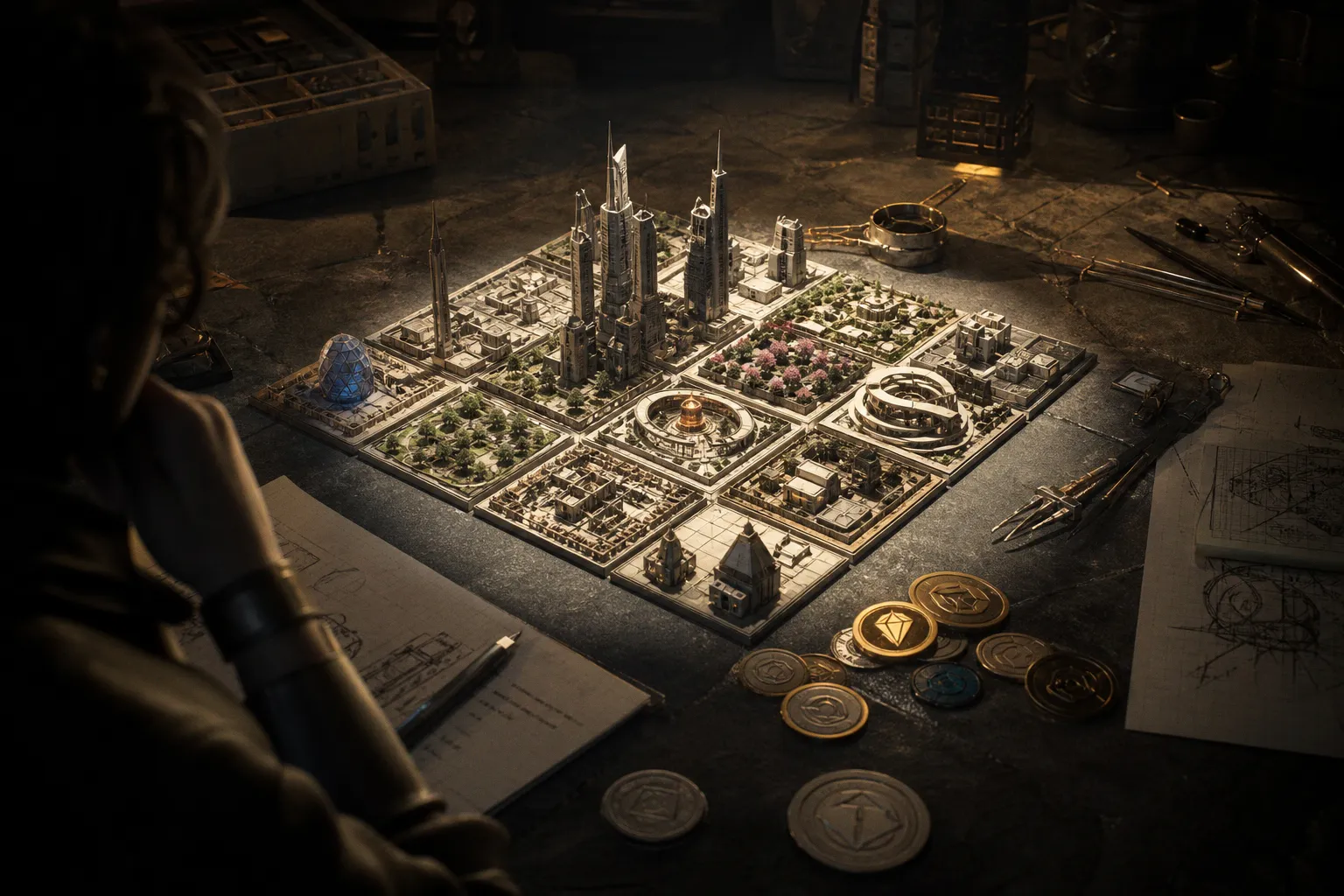
The world that gives that record meaning does not.
That distinction is the entire market.
Decentraland has 90,601 parcels in Genesis City, each measuring 16 by 16 metres. The Sandbox has 166,464 LAND parcels, each measuring 96 by 96 metres. These numbers are often presented as scarcity metrics. They are more accurately capacity parameters. They define how much mapped space exists. They do not create footfall, creator demand, rendering performance, or a reason for anyone to return.
The question “what is virtual real estate” therefore has a narrow technical answer: an NFT representing rights to use a designated area of a metaverse map, subject to the rules, clients, smart contracts, moderation systems, and deployment tools of that specific world.
Digital property is an NFT plus a platform dependency
Most metaverse land is represented by an ERC-721-style non-fungible token on Ethereum. The token can identify a parcel or an estate assembled from adjacent parcels. It can be transferred between wallets. It can, in some cases, be used as collateral or offered through a marketplace. These properties are real at the token layer.
They are incomplete at every other layer.
A parcel does not contain a virtual building in the same way a hard drive contains a file. It points into a platform’s spatial and content system. The owner needs the platform’s client to render the world, its servers or distributed delivery stack to serve assets, its SDK to interpret interactive logic, and its governance process to preserve the rules around that coordinate.
The ownership stack has several separate parts:
- Token ownership. A wallet controls the NFT. This is the clearest and most portable component.
- Spatial assignment. The token maps to coordinates on a named world map. Without the map, coordinates are not useful.
- Content deployment rights. The platform decides how scenes, assets, scripts, and updates are published.
- Runtime access. Visitors need a working client, compatible browser or headset support, sufficient bandwidth, and an account or wallet flow that does not impose excessive friction.
- Economic utility. Rental, commerce, ticketing, advertising, and branded installations depend on actual user traffic rather than token supply.
This is why “digital property” is a more careful term than “virtual land.” Land implies independent utility. A metaverse parcel has derived utility. Its value is downstream of a single environment’s throughput, social density, creator tooling, and governance stability.
An NFT can prove control of a coordinate. It cannot prove that the coordinate has an audience.
The distinction became visible after the 2021–2022 cycle. Average virtual land prices reached roughly $15,000 to $18,000 at the peak, while individual plots sold for millions. A Decentraland Fashion Street plot changed hands for $2.4 million in November 2021. By 2024, average floor prices across the sector had fallen by as much as 95% from their highs.
The correction did not invalidate blockchain ownership. It exposed the missing layer: demand for the runtime world.
Sandbox vs Decentraland real estate: supply is not a common unit
A metaverse land comparison often starts with parcel count and ends there. That is inadequate because the parcels are not interchangeable units. Their dimensions, visual systems, content tools, and intended user behaviour differ.
| Parameter | Decentraland | The Sandbox |
|---|---|---|
| Total parcel supply | 90,601 parcels | 166,464 LAND parcels |
| Individual parcel dimensions | 16m × 16m | 96m × 96m |
| Primary native token | MANA | SAND |
| Core orientation | Social spaces, events, commerce | User-generated voxel games |
| Primary creation tools | SDK and Scene Editor | VoxEdit and Game Maker |
| Basic land function | Deploy a scene at a fixed map coordinate | Build and publish interactive game experiences |
The Sandbox has a larger nominal parcel supply and much larger stated in-world parcel dimensions. That does not mean one Sandbox LAND is automatically “worth more space” than a Decentraland parcel. Metres inside isolated virtual coordinate systems are not standardized measurements of commercial capacity. They are engine-level conventions.
What matters is buildable density and visitor routing.
In Decentraland, proximity can matter because the map supports social discovery, events, galleries, branded spaces, and commerce-oriented destinations. A parcel near an active district or frequently visited venue has a plausible traffic argument. That argument still depends on whether the platform’s navigation patterns, event programming, and client performance deliver visitors to the area.
The Sandbox frames LAND more as a production surface for games and interactive experiences. Its voxel aesthetic and Game Maker workflow lower the conceptual barrier for creators building block-based environments. But game creation does not solve discovery. A technically competent experience can remain invisible if players do not enter, if loading latency is high, or if the broader platform lacks a durable loop that moves users from one experience to another.
The finite supply claim also requires inspection. Neither platform can produce an infinite number of original parcels without changing a core map parameter. That is useful. It prevents direct supply expansion from silently diluting existing coordinates. But scarcity of lots is only one variable. The supply of competing attention is effectively unlimited: browser games, social platforms, live-service titles, video channels, chat servers, and other virtual worlds all compete for the same session time.
A fixed map does not create a fixed demand curve.
Two different utility models: social venue versus game surface
Decentraland’s architecture is oriented toward persistent social and commercial spaces. Its SDK and Scene Editor allow owners and developers to build environments, deploy interactive elements, host events, and create branded or community-facing venues. The operating premise is that users will gather in a shared 3D setting because the setting makes interaction more useful or more legible than a conventional web page.
This is a demanding premise.
Social worlds need concurrency. A venue with ten people distributed across a large map does not feel populated. It feels underutilized. The platform must manage rendering, asset delivery, spatial audio, avatar synchronization, and wallet-linked identity without making the entry process slower than the event itself. Every extra signature request, extension conflict, download, or shader failure increases abandonment.
The Sandbox takes a different route. Its core asset pipeline is voxel-based. VoxEdit supports 3D voxel asset creation. Game Maker is intended to let creators assemble interactive game experiences. The platform’s land is therefore closer to a constrained game-development environment than to a blank commercial plot.
That model has a clearer unit of output. A creator can build a game loop. The problem is harder elsewhere: sustaining replay value, surfacing content, and establishing consistent quality controls across a creator ecosystem.
Neither platform escapes central points of dependency:
1. The client remains a gatekeeper. A browser client, launcher, or supported device determines whether the world is usable. NFT ownership does not remove this dependency.
2. The content pipeline defines practical freedom. SDK versions, scene limits, asset formats, and publishing rules determine what owners can actually deploy.
3. Discovery is centralized in practice. Even where ownership is on-chain, featured placements, portals, search, events, and default navigation shape traffic flows.
4. Governance is slow by design. Token governance can formalize proposals, but it does not guarantee quick responses to rendering regressions, abuse, or broken content.
5. Interoperability remains partial. An avatar wearable, voxel asset, or building scene has limited value outside the platform built to render it.
The last point is routinely overstated in marketing. A wallet can move between ecosystems. A 3D identity does not automatically move with it. Mesh standards, animation rigs, item metadata, moderation policies, collision logic, and game balance are not resolved by token transfer.
An asset can be portable as a record and unusable as an object.
The blockchain handles ownership transfer. The platform still controls the experience layer.
This is also where virtual concerts and esports-style events become a useful stress test. The event can create a temporary reason to enter a world, but the event does not repair its underlying retention mechanics. The same distinction exists in conventional competitive gaming: a high-stakes tournament can concentrate attention around a short window, as shown by the ALGS Split 1 Playoffs in Paris, but the audience is supported by a mature game loop, teams, ranking systems, spectator infrastructure, and a reliable schedule. A metaverse venue starts with the venue. It still has to build the surrounding system.
Buying virtual real estate means buying exposure to platform execution
Buying virtual real estate is often described as buying a location. Structurally, it is closer to acquiring a long-duration claim on a platform’s ability to keep one virtual coordinate relevant.
The transaction itself is straightforward. A user acquires a land NFT with a compatible wallet and pays in the ecosystem’s required currency or through a marketplace route. Decentraland uses MANA for land and in-world assets. The Sandbox uses SAND for marketplace activity, transactions, and governance-related functions.
The operational risk begins after settlement.
A landholder should separate four claims that are commonly merged into one:
| Claimed benefit | What is actually required |
|---|---|
| “I own the land” | Continued control of the NFT and recognition of its mapping by the platform |
| “I can build on it” | Supported tools, publishing access, technical skill, and maintained content |
| “I can monetize it” | Visitors, payments infrastructure, a viable offer, and low enough user friction |
| “It is scarce” | Fixed supply plus demand that prefers this map over alternatives |
The monetization layer is particularly weak when inspected without token-price assumptions. Renting a virtual venue requires renters with a purpose. Selling digital fashion requires avatars that users treat as persistent identities. Running a ticketed event requires a reason not to use a stream, a Discord server, a game already holding the audience, or a conventional website.
These are not theoretical objections. They are throughput constraints.
A world can issue many parcels faster than creators can populate them with competent experiences. Creators can publish experiences faster than users can discover them. Users can enter faster than they form stable communities. At every stage, supply can outpace demand.
The physical-real-estate analogy fails here because physical space has non-substitutable geography. A shop on a busy street benefits from the street’s unavoidable location. A virtual parcel sits one click away from every other environment on the internet. Its adjacency is meaningful only if the platform’s navigation system makes it meaningful.
Decentraland’s smaller 16-by-16-metre parcels may encourage aggregation into larger estates for substantial builds. The Sandbox’s 96-by-96-metre LAND format gives creators a different spatial canvas. Neither configuration solves the central issue: whether users will repeatedly traverse the map rather than arrive once for a campaign activation and leave.
The 95% correction was a demand audit
The late-2021 and early-2022 surge in metaverse land prices was not merely speculation in the abstract. It priced in a broad set of assumptions simultaneously: mainstream headset adoption, persistent avatar identities, strong virtual commerce, corporate demand for branded spaces, creator-led game economies, and rising token liquidity.
Most of these assumptions required long implementation cycles. Prices moved first.
The subsequent decline of up to 95% in average floor values was therefore an audit of unsupported expectations. It did not show that a tokenized parcel cannot be transferred. It showed that transferability is a weak substitute for cash flow, audience retention, and functional interoperability.
There is a second technical issue. Floor price is a thin metric in markets where many assets are heterogeneous and transactions are irregular. A low-priced sale can reset a visible floor without establishing broad liquidity. A high-priced sale can reflect a special coordinate, a marketing deal, an adjacent estate, or a one-off buyer. Neither is a complete indicator of usable demand.
For platform analysis, better questions are operational:
- How quickly can a new visitor enter a live scene and understand what to do?
- How much latency occurs before avatars, assets, and interactive objects are available?
- Can a creator update an experience without rebuilding an entire production pipeline?
- Does the platform offer reliable discovery beyond paid promotion or a featured placement?
- Are there recurring social or game loops that exist independently of land speculation?
- Can content survive changes to SDKs, clients, and marketplace rules?
These questions are less glamorous than a sales record. They decide whether a plot can function as more than a ledger entry.
The reported global metaverse real estate market estimate of $2.33 billion for 2025, rising to $3.03 billion in 2026 and potentially $8.61 billion by 2030, should be read in that context. The projected 29.8% compound annual growth rate is an estimate, not a network measurement. It does not establish daily active users, session duration, transaction liquidity, or creator earnings for Decentraland and The Sandbox.
Market-size projections aggregate categories that can have very different technical foundations. A branded virtual showroom, an NFT coordinate, an enterprise simulation environment, and an augmented-reality property layer are not interchangeable products merely because each is described as metaverse real estate.
The architectural verdict
Decentraland and The Sandbox are not competing for exactly the same use case.
Decentraland is a social-commerce world with land as persistent venue infrastructure. Its bottleneck is density. It needs recurring users, usable events, and navigation patterns that turn coordinates into destinations.
The Sandbox is a creator-game platform with land as an experience-building surface. Its bottleneck is production and discovery. It needs games that hold players, tooling that reduces build friction, and a distribution layer that does not leave creators competing in a silent map.
Both retain a basic centralization problem. The ownership token is decentralized relative to a conventional account database. The world’s practical utility remains dependent on platform clients, technical standards, content rules, and attention-routing mechanisms. The chain records the deed. It does not operate the city.
The binary verdict is straightforward.
Scalability of ownership: yes. NFTs can transfer parcel control with clear on-chain settlement.
Scalability of utility: not yet proven. Neither fixed parcel supply nor token governance resolves the harder requirements: low-latency access, durable discovery, creator throughput, and recurring human presence. Until those layers are reliable, virtual real estate remains a platform-bound digital property claim, not a self-sustaining real estate market.