Select Decentralized Storage for Web3 Game Assets
A game's asset manifest is a liability ledger. Every texture, model, and metadata JSON carries a persistence risk.
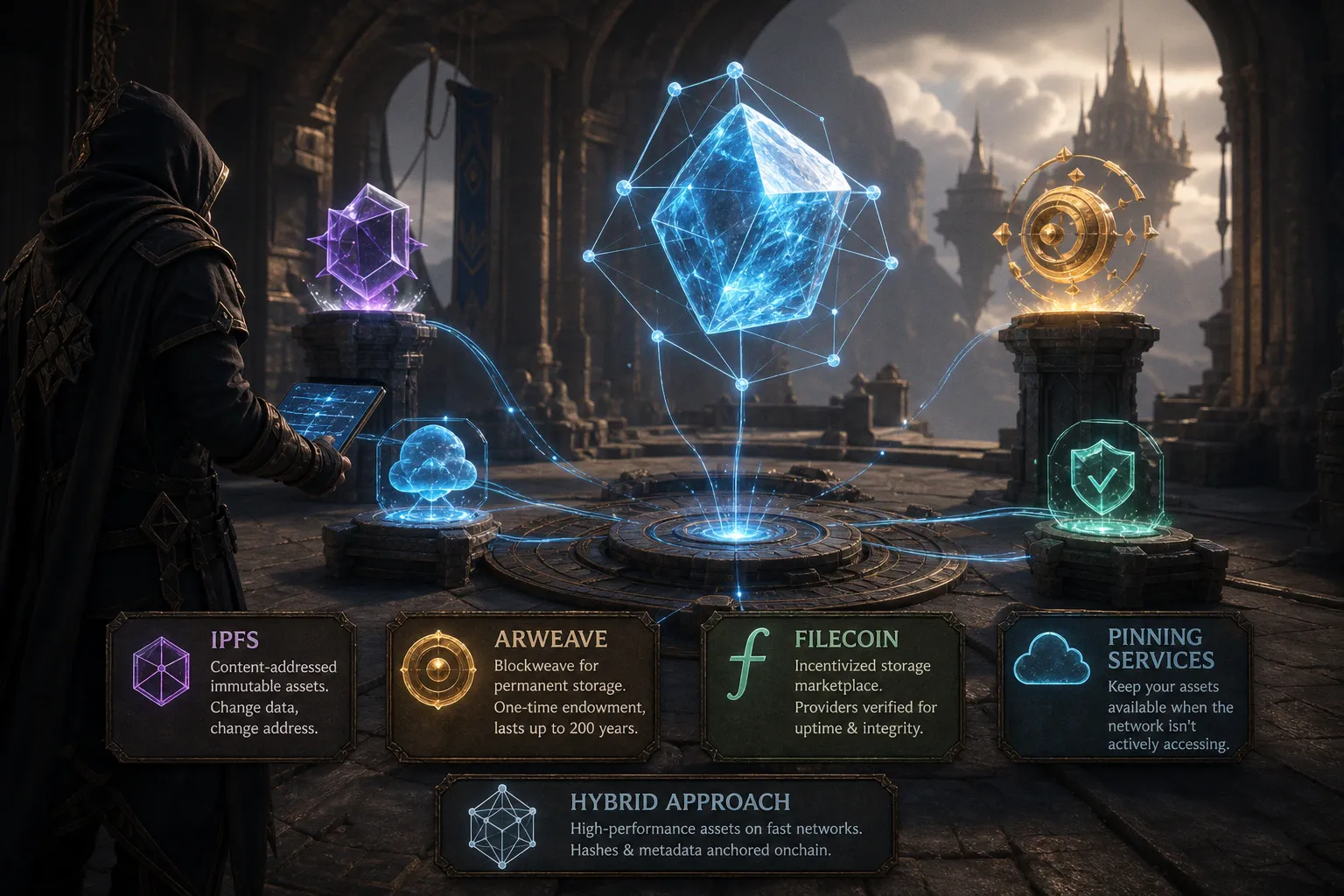
Selecting Decentralized Storage for Web3 Game Assets
The core problem: traditional cloud storage offers sub-100ms latency and five-nines durability, but centralizes control and creates a single point of failure. Decentralized protocols promise censorship resistance and player ownership, but introduce new variables: data availability proofs, retrieval speeds measured in seconds or minutes, and opaque pricing models. Selecting the right one requires stress-testing each protocol against the specific data lifecycle of a game asset.
Content-Addressing vs. Permanent Storage: Matching Protocols to Asset Types
Not all game data is equal. A weapon skin NFT's metadata has different latency tolerances and persistence requirements than a player's high-frequency position stream. The first architectural decision is mapping data types to storage primitives.
IPFS uses content-addressing. A file's cryptographic hash, its CID (Content Identifier), is its address. Change a single pixel in a texture, and the CID changes entirely. This makes IPFS ideal for immutable assets: final art, audio files, static 3D models, and token metadata. The data is inherently verifiable—the hash proves integrity. However, IPFS alone is a distribution protocol, not a persistence guarantee. Nodes in the swarm cache data temporarily. Without active pinning, a rare asset could become unavailable if no node chooses to store it.
Arweave, by contrast, is a persistence protocol. Its "blockweave" architecture and endowment model are designed for permanent storage. You pay a one-time fee calculated to ensure data availability for approximately 200 years. This is a compelling proposition for canonical game lore, immutable character backstories, or core smart contract ABIs. The trade-off is latency. Fetching data from Arweave is an archival operation, not a real-time CDN call.
The CID is a fingerprint, not a warehouse address. It tells you what the data is, not where to get it quickly.
Filecoin occupies a middle ground as an incentive layer atop IPFS. It creates a marketplace where storage providers are paid to store data, with cryptographic proofs (Proof-of-Replication, Proof-of-Spacetime) verifying they're doing the job. This can provide stronger persistence guarantees than IPFS pinning alone, but the retrieval process is more complex and often slower, optimized for verifiable storage over instantaneous access.
The Role of Pinning Services and Incentive Layers in Data Availability
Choosing IPFS or Filecoin for asset storage without a pinning strategy is a design flaw. A pinning service—like Pinata or Web3.Storage—acts as a dedicated, always-on node that "pins" your CIDs, ensuring they remain available in the IPFS network regardless of what other nodes do. This is a operational necessity for game assets, where a sudden unavailability of a popular sword skin would be catastrophic for user experience.
Filecoin's incentive model is its native pinning solution. You make a storage deal with a provider, they lock collateral, and the protocol's consensus mechanism verifies the data's integrity over time. This is more trust-minimized than relying on a commercial pinning service, but it's not without friction. Deals must be initiated, renewed, and can be subject to provider market rates.
For a live game, the question isn't if you need a pinning layer, but which one. A commercial service offers predictable SLAs and developer-friendly APIs. A Filecoin deal offers cryptographic assurance but requires more protocol-level management. Many projects use both: pinning with a service for immediate availability while making Filecoin deals for long-term archival redundancy.
Verifiable Integrity: Understanding Proof-of-Replication and Spacetime
Filecoin's consensus mechanisms are its core technical differentiator. They move storage from a promise to a cryptographically verifiable fact.
Proof-of-Replication (PoRep) is performed once when a storage deal is made. It proves that a provider has created a unique physical copy of your data, sealed it in a way that's tied to their identity, and committed it to the network. This prevents providers from claiming to store 10 copies while only storing one, a critical protection against shoddy redundancy.
Proof-of-Spacetime (PoSt) is the ongoing audit. Network miners must periodically submit proofs that they are still storing the same sealed data over time. Failure to submit these proofs results in slashing of their collateral. This creates a continuous economic incentive for honest behavior.
For a game developer, this translates to a higher assurance of data durability. However, the latency and complexity cost is real. A PoSt cycle might have a 30-minute to 1-hour window. Retrieval from a Filecoin miner is not a simple HTTP GET request; it often requires initiating a retrieval deal and waiting for the miner to unseal the data. This latency is prohibitive for client-side asset streaming during gameplay.
Hybrid Infrastructure: Balancing Decentralization with Retrieval Latency
Pure decentralized storage fails the sub-200ms latency requirement for real-time game clients. The pragmatic architecture is a hybrid one, using each layer for its intended purpose.
The optimal stack for a Web3 game looks like this:
1. Real-Time Asset Layer (CDN/Cloud): High-resolution textures, complex 3D models, and audio assets live on a traditional CDN (like Cloudflare R2 or AWS CloudFront). This guarantees the low latency needed for smooth gameplay. The hash of each asset file, however, is stored on-chain or in a decentralized store, creating a verifiable link between the fast-delivered asset and its immutable source.
2. Canonical Decentralized Layer (IPFS/Filecoin): Immutable NFT metadata, game lore documents, token schemas, and final "golden" versions of assets are pinned on IPFS and/or stored via Filecoin deals. This serves as the source of truth. When a player verifies their asset's provenance, they check against this layer.
3. Permanent Archive Layer (Arweave): Core smart contract code, immutable game state snapshots, and foundational protocol documentation are written to Arweave. This is the "write once, read rarely" layer for data that must exist as long as the chain does.
This hybrid model respects the physics of network latency while using decentralization for its strengths: integrity verification, player ownership, and censorship resistance.
Economic Models: Calculating Long-term Costs for Game Asset Persistence
The cost of storage isn't a line item; it's a curve. IPFS pinning with a service like Pinata operates on a subscription model—predictable monthly fees based on total data stored and bandwidth used. For a game with 500GB of total assets, this might run from tens to a few hundred dollars per month, a simple operational expense.
Arweave's endowment model is a one-time capital expense. The cost is calculated based on data size and the current price of the AR token, with the fee designed to cover storage for 200 years. For 500GB, this could be a substantial upfront cost, but it eliminates ongoing fees entirely. The risk is tied to the protocol's long-term viability.
Filecoin deals are a variable marketplace. Storage costs fluctuate based on provider supply and demand. While often cheaper than Arweave for the first few years, the total cost over decades is unknown and requires active deal renewal. This introduces operational overhead and cost uncertainty.
| Protocol | Cost Model | Persistence Guarantee | Retrieval Latency | Primary Use Case |
|---|---|---|---|---|
| IPFS + Pinning | Recurring subscription (OPEX) | Relies on service SLA | Fast (CDN-backed) | Active, immutable assets (metadata, final art) |
| Arweave | One-time endowment (CAPEX) | ~200 years (protocol claim) | Slow (archival) | Permanent archival, immutable game lore |
| Filecoin | Variable marketplace deals | Cryptographically verifiable | Moderate to slow | Verifiable cold storage, backup redundancy |
The financial decision hinges on your game's time horizon and risk appetite. A live-service game needing predictable budgets will favor IPFS pinning. A project banking on cultural permanence might amortize Arweave's cost over decades. Filecoin suits projects requiring auditable storage for compliance or trust minimization, provided they can tolerate the operational complexity.
There is no decentralized free lunch. You pay for persistence with latency, for verifiability with complexity, and for permanence with upfront capital.
The final verdict is clear: no single protocol solves all problems. A scalable Web3 game requires a carefully architected, layered storage strategy. Use IPFS for content-addressed distribution, pin it for availability, and leverage Filecoin or Arweave for verifiable persistence where the economics make sense. Accept the hybrid reality, or accept the operational flaws of a pure-play approach. The latter is not a technical risk worth taking.