Compare Sandbox and Decentraland Land for Event Hosting
Hosting an event in a metaverse used to mean firing up a browser tab and hoping for the best.
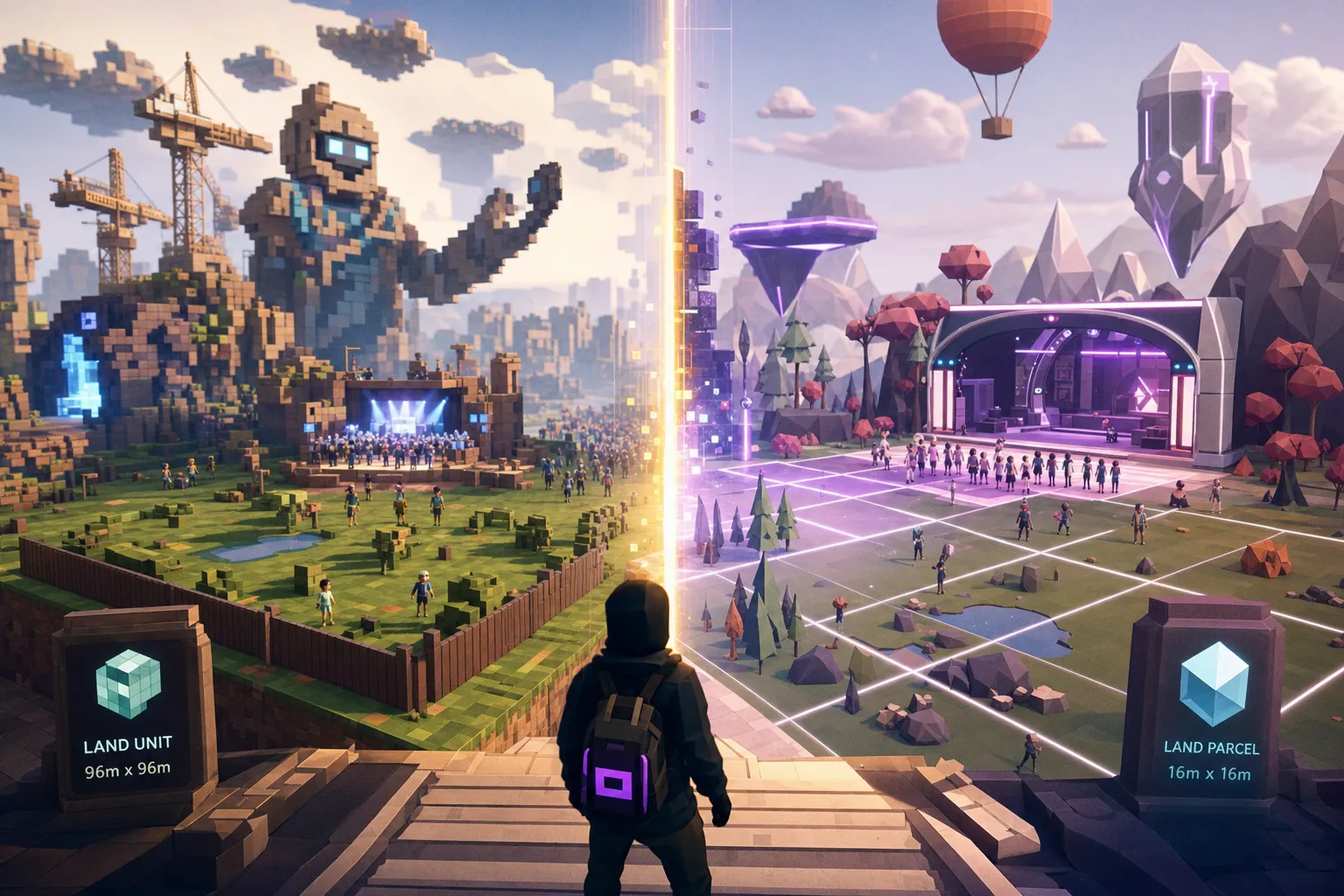
The cost of entry starts with land. A single Decentraland parcel — a 16m × 16m tile on its grid — has historically traded in the low hundreds of dollars, though prices swing with MANA's token price and parcel location. The Sandbox LAND, by contrast, comes in 96m × 96m plots, with estates bundling multiple plots into 3×3, 6×6, 12×12, or even 24×24 configurations. A single SAND-denominated plot can run anywhere from a few hundred to several thousand dollars depending on proximity to major partners' estates. You don't have to buy, of course — both platforms support renting — but understanding the real estate you're working with is step one.
Accessibility and User Friction: Browser vs. Client-Based Entry
The single biggest difference between hosting on Decentraland and hosting in The Sandbox comes down to one question: does your audience need to download anything?
Decentraland runs in a browser. A Chrome tab, a wallet connection (MetaMask, WalletConnect, or a few others), and you're in. No 2 GB installer, no waiting for assets to stream. For event organisers, this is enormous. Every additional step in the onboarding funnel is a leak, and Decentraland's friction floor is about as low as a blockchain-based platform gets. If someone sends you a link to a specific coordinate, you click it, connect, and walk in. The barrier is a wallet setup — which, for non-crypto natives, is still a hurdle — but there's no software gatekeeping the experience.
The Sandbox requires a download. The Game Client is available for Windows (with Mac support evolving), and the experience is a standalone application. For seasoned players already grinding through Sandbox experiences and earning SAND through gameplay loops, this is a non-issue — the client is already on their machine. But for a one-off event attendee? That download is friction, pure and simple.
The rule of thumb: Decentraland optimises for "show up now" accessibility. The Sandbox optimises for depth of experience once you're inside.
For a brand running a virtual concert with broad appeal, Decentraland's browser entry catches more casual traffic. For a guild running a week-long quest event with leaderboard mechanics, The Sandbox's client-based environment offers the fidelity and control needed to make the grind worthwhile.
Spatial Dimensions and Land Architecture: 16m Parcels vs. 96m Units
The physical grid layout of each platform shapes what your event can actually look and feel like.
Decentraland's world is built on a strict parcel grid: each LAND token is a 16m × 16m square, and the total supply caps at 90,601 parcels. Adjacent parcels can be combined into Estates, but the fundamental building block stays small. This means event designers work within a modular system — think of it like building with Lego bricks. Want a sprawling festival ground? You'll need to acquire or rent multiple contiguous parcels and stitch them together. The upside is precision: every 16m tile can hold a different scene, a different interactive moment, a different vendor booth.
The Sandbox takes the opposite approach with its 96m × 96m LAND tokens, totalling 166,464 parcels. Each single LAND is already a substantial canvas — roughly 36 times the area of a Decentraland parcel. Estates scale this up further. If Decentraland is Lego, The Sandbox is a blank canvas stretched across a table. A single LAND can comfortably hold a full experience — a game level, a branded world, a multi-zone event — without requiring adjacent purchases.
| Dimension | Decentraland | The Sandbox |
|---|---|---|
| Base parcel size | 16m × 16m | 96m × 96m |
| Total LAND supply | 90,601 parcels | 166,464 parcels |
| Estate combinations | Adjacent parcels merged | 3×3, 6×6, 12×12, 24×24 |
| Primary spatial feel | Modular, grid-based | Expansive, canvas-based |
For event hosting, this distinction matters practically. If you're planning an intimate, multi-room venue — say, an art gallery with distinct exhibition halls — Decentraland's parcel-by-parcel approach gives you fine-grained control over each room's content and interactivity. If you're planning an open-world experience with sprawling grounds, obstacle courses, or large-scale social zones, The Sandbox's larger LAND footprint lets you build that without the compositional gymnastics of parcel stitching.
Creative Toolsets: Game Maker Quests vs. SDK Scenes
Here's where the platforms diverge most sharply in what your event can actually do.
The Sandbox's Game Maker is, frankly, a standout tool for event creators. It's a no-code environment that lets you deploy interactive mechanics — quest systems, combat encounters, NPC dialogues, collectible spawns, and timed challenges — without writing a single line of code. The drag-and-drop interface works with voxel assets (either from The Sandbox's marketplace or custom-built in VoxEdit), and the output is a playable experience with real gameplay loops.
For an event, this means you can build a treasure hunt. You can create a boss fight. You can design an obstacle course with a leaderboard. You can layer in reward systems tied to SAND or NFT distribution. The event becomes a game, and the engagement metrics reflect that — players have a reason to stay, explore, and return.
Decentraland's creative pipeline runs through its Builder tool and the SDK. The Builder is a visual editor for arranging 3D scenes — furniture, structures, wearable displays, and environmental art — on your parcels. For social events, this is perfectly adequate: you can design a stage, a dance floor, a meeting hall, or a retail space. The SDK goes deeper, allowing developers to script interactive elements — NPCs, mini-games, wearable shops, and custom UI overlays — using TypeScript. But the SDK requires actual coding knowledge, which narrows the creator pool considerably.
1. Game Maker (The Sandbox): No-code, gamified experiences with quest logic, combat systems, and reward mechanics. Best for events designed around participation loops and repeat engagement.
2. Builder (Decentraland): Visual scene composition for social, commercial, and exhibition spaces. Lower ceiling but faster deployment for straightforward layouts.
3. SDK (Decentraland): TypeScript-based scripting for custom interactivity. High ceiling, steep learning curve. Essential for complex event mechanics but requires developer resources.
The practical takeaway: if your event is social — a concert, a networking mixer, a brand launch — Decentraland's Builder gets you there faster with less technical overhead. If your event is participatory — a quest, a tournament, a game-within-a-game — The Sandbox's Game Maker gives you mechanics that Decentraland's tools simply don't match without custom SDK work.
Strategic Use Cases: Matching Event Goals to Platform Infrastructure
Not every event needs the same engine. Here's how the two platforms line up against common event archetypes.
Virtual concerts and live performances. Decentraland has hosted these extensively — its Genesis Plaza and partner venues have seen musical acts, DJ sets, and live-streamed performances. The browser entry means a wider potential audience, and the spatial audio capabilities in Decentraland support proximity-based sound. The Sandbox has hosted events too, but the download requirement creates a natural ceiling for casual attendees. If your goal is maximum eyeballs for a single-night event, Decentraland's infrastructure is purpose-built for it.
Product launches and brand activations. Both platforms handle these well, but the mechanics differ. Decentraland excels at showroom-style activations — walk through a virtual store, interact with NFT displays, claim wearables. The Sandbox lets you turn the activation into a playable experience: complete a quest to unlock a limited-edition item, explore a branded world with hidden content. The choice depends on whether you want attendees to browse or to play.
Community tournaments and competitive events. This is The Sandbox's home turf. Game Maker's mechanics — scoring systems, timed challenges, spawn points, health/damage models — make competitive events feasible without hiring a development team. Decentraland can host competitive events through SDK scripting, but the build effort is significantly higher for comparable functionality.
Educational workshops and conferences. Decentraland's lower barrier to entry makes it a strong candidate for knowledge-sharing events where the audience isn't necessarily gamer-native. The Builder tool lets you set up presentation spaces, and the SDK allows for interactive educational elements. The Sandbox's gamified environment can work for youth-oriented educational events, but the client download and gaming aesthetics may feel incongruent with a corporate workshop.
Decentraland is your lobby. The Sandbox is your playground. Match the event to the venue.
Navigating the Rental Market: Leasing Virtual Real Estate
Buying land isn't always the move — especially for one-off or seasonal events. Both platforms support renting through NFT-based lease agreements, but the rental ecosystems have different textures.
In Decentraland, land rental is facilitated through platforms that list available parcels by coordinates, traffic data, and proximity to landmarks. Because parcels are smaller and more numerous, the rental market is relatively liquid: there's usually something available in a neighbourhood that fits your spatial needs and budget. Lease terms vary — some landowners offer daily rates for event weekends, others prefer weekly or monthly commitments. The browser-based nature of the platform also means your event setup and teardown don't require tenants to update installed software.
The Sandbox rental market operates similarly but with the added complexity of larger land units and estate configurations. Renting a single 96m × 96m LAND gives you substantial real estate, but if you need adjacency — say, for a multi-zone event — you'll want an estate rental, which requires negotiating with a single landowner controlling multiple plots. The rental market here can be less liquid due to the higher value per unit and the smaller pool of estate holders willing to lease.
For event organisers working on a timeline, the practical checklist looks like this:
- Scope your spatial needs first. How many parcels (Decentraland) or what estate size (The Sandbox) does your event design require? Build the concept before shopping for land.
- Check proximity to high-traffic zones. In both platforms, foot traffic clusters around landmarks, partner venues, and Genesis Plaza equivalents. Leasing near these hubs improves organic discovery.
- Negotiate lease terms around your event lifecycle. Setup, event window, and teardown all need to be covered. Some landowners offer flexible terms; others prefer fixed commitments.
- Factor in content deployment time. Decentraland scene publishing is relatively quick once built. The Sandbox experience publishing through Game Maker also follows a streamlined pipeline, but testing across the full experience loop takes longer for complex game mechanics.
Both platforms' NFT-based ownership models mean lease agreements are transparent and verifiable on-chain — a meaningful improvement over the opaque venue rental models of traditional event spaces. But "transparent" doesn't mean "cheap." Virtual real estate prices, denominated in volatile tokens like MANA and SAND, fluctuate with broader crypto market sentiment. Budget in token terms, not dollar terms, and build in a buffer.
Wrapping Up: Worth Your Time?
After spending time in both environments — walking Decentraland's grid, jumping through Sandbox experiences, and talking to creators who've built on each — the answer isn't "one is better." It's "better for what?"
If your event lives or dies on how many people walk through the door with minimal fuss, Decentraland's browser-based accessibility is a structural advantage you can't replicate in a client-based platform. If your event lives or dies on how engaging the experience is once people arrive — the depth of the gameplay loop, the quality of the interactive mechanics, the reason to come back — The Sandbox's creative toolset delivers a level of gamification that Decentraland simply can't match without significant custom development.
For organisers serious about long-term metaverse presence, the answer might genuinely be both: Decentraland for broad-reach social activations and community touchpoints, The Sandbox for flagship gamified experiences that reward deeper engagement. The two platforms aren't competing for the same slice of your event calendar — they're complementary stages in an increasingly multi-platform virtual landscape.
The virtual real estate market is volatile, the tech is still maturing, and the audiences are niche. But if you're already committed to hosting in the metaverse, understanding where each platform's infrastructure shines — and where it falls short — is the difference between an event that feels like a ghost town and one that feels like a living world.