Layer 2 blockchain scaling: key requirements for Web3 games
Ethereum mainnet processes roughly 15 to 30 transactions per second. A single battle royale match involving 100 players executing movement, weapon swaps, and inventory updates every few hundred…
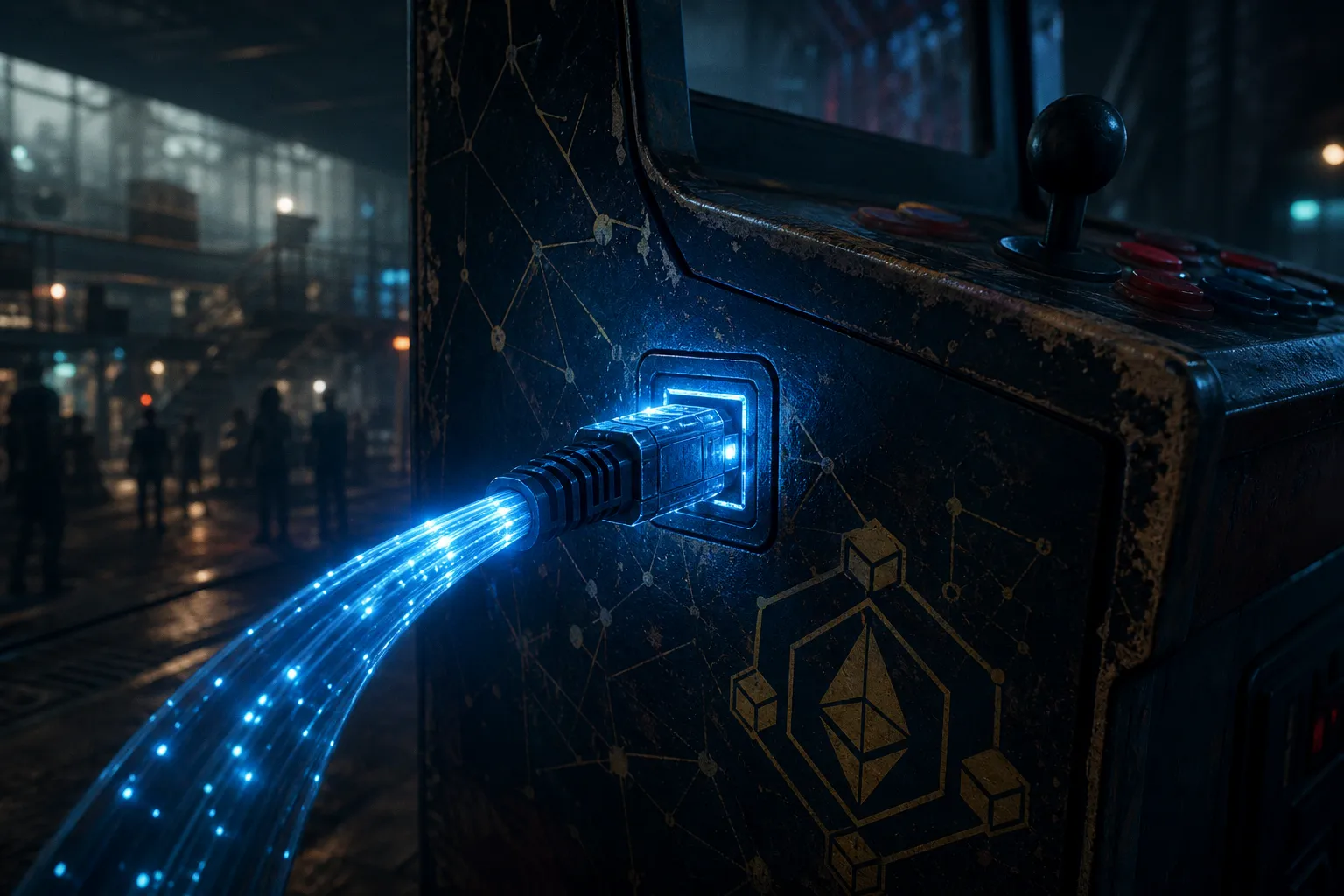
The Throughput Ceiling
Ethereum mainnet processes roughly 15 to 30 transactions per second. A single battle royale match involving 100 players executing movement, weapon swaps, and inventory updates every few hundred milliseconds will generate more on-chain transactions than Ethereum settles in several minutes. This is the bottleneck. It is not theoretical. It is arithmetic.
Gas fees reinforce the wall. During periods of network congestion, a single token swap or ERC-20 approval on L1 can cost more than an entire gaming session is worth to the player. Latency compounds the problem. Block times of 12 seconds on Ethereum are incompatible with the sub-second responsiveness that competitive or even casual play demands. A player who fires a weapon and waits 12 seconds for confirmation is not playing a game. They are submitting paperwork.
Layer 2 blockchain solutions exist to remove this ceiling. They do so by moving execution off the main chain while inheriting its security guarantees. For Web3 gaming, the requirement is not abstract throughput. It is a specific envelope: sub-second block times, near-zero per-transaction cost, finality that does not interrupt gameplay, and asset portability across chains. Anything that fails to meet that envelope is not a scaling solution for games. It is a settlement layer for something else.
Rollup Architectures: Two Routes to the Same Destination
The dominant L2 designs fall into two categories: Optimistic Rollups and ZK-Rollups. Both bundle transactions off-chain and post compressed data to L1 for eventual settlement, but they diverge sharply on how they prove validity.
Optimistic Rollups, deployed by Arbitrum and Optimism among others, assume transactions are valid by default. A challenge window — typically seven days — follows each batch posted to L1. During that window, any node can submit a fraud proof to dispute an invalid state transition. If no dispute lands, the batch is finalized. This architecture is mature, EVM-equivalent at the bytecode level, and significantly cheaper than L1 execution. The trade-off is finality. Withdrawals back to L1 wait for the challenge period to close. For a game, this matters less for in-game actions (which never leave L2) and more for any economic flow that touches L1 settlement — marketplace exits, prize payouts, treasury operations.
ZK-Rollups take the opposite approach. Every batch ships with a cryptographic validity proof — a SNARK or STARK — that mathematically confirms the transactions are correct before L1 accepts them. There is no challenge window. Finality is sub-second to a few minutes, depending on prover hardware and proof system complexity. The historical cost has been computational overhead at the prover level and limited EVM compatibility. Newer zkEVM implementations, including those from zkSync and Polygon (the Polygon zkEVM lineage, formerly Hermez), have closed much of that compatibility gap while keeping proof generation costs manageable on standard prover hardware.
StarkNet sits in a different category. It is a ZK-rollup, but it is not a zkEVM. Its execution environment is the Cairo VM, a purpose-built stack designed to make STARK proofs cheap to generate rather than to mirror EVM semantics at the bytecode level. The result is a network that can prove enormous batches with relatively modest prover hardware, and that supports flexible execution features (account abstraction at the protocol level, cheaper recursion, parallelizable proving). The cost is that game teams cannot drop an EVM codebase onto it. Contracts are written in Cairo, or compiled to it. For studios porting an existing Solidity title, that is a meaningful rewrite. For studios building greenfield, the trade-off shifts toward ZK-native efficiency over EVM tooling familiarity.
| Parameter | Optimistic Rollup | ZK-Rollup (zkEVM) | ZK-Rollup (non-EVM, e.g. StarkNet) |
|---|---|---|---|
| Validity mechanism | Fraud proof (assumed valid) | Validity proof (cryptographic, EVM-equivalent) | Validity proof (cryptographic, Cairo VM) |
| L1 withdrawal delay | ~7 days (challenge period) | Sub-second to minutes | Sub-second to minutes |
| EVM compatibility | High (full bytecode equivalence) | Improving rapidly | None — requires Cairo / porting |
| Per-tx cost on L2 | Typically < $0.01 | Typically < $0.01 | Typically < $0.01, often lower at scale |
| Best fit for games | Session-heavy, low-bridge activity | High-value asset minting, EVM-native teams | High-throughput worlds, ZK-native teams |
For game economies that move large volumes of low-value transactions internally and only occasionally touch L1, all three architectures are viable in principle. The friction point is the bridge — and the trust model underneath it.
A rollup is not a destination. It is a compression layer. The game economy must still settle somewhere.
The Account Abstraction Layer
Even with sub-second block times and near-zero gas, the player experience breaks down at the wallet boundary. Requiring a user to confirm every transaction with a hardware pop-up, manage a 12-word seed phrase, and hold a native gas token in a separate wallet is friction that mainstream players will not tolerate. Account Abstraction, formalized as ERC-4337 and deployed on Ethereum mainnet in 2023, addresses this directly.
ERC-4337 separates the signer from the account. A smart contract wallet becomes the player's identity on-chain, and transaction logic moves into that contract. The practical consequences for games are concrete and immediate:
- Gasless transactions. The game operator can sponsor gas from a paymaster contract or pay it from a pre-funded session key, removing the need for players to ever acquire the native L2 token. This collapses the "where do I get ETH to play?" onboarding cliff.
- Session keys. A player can authorize a temporary key with scoped permissions — "move this character for the next hour, spend up to 10 tokens per action" — and use it without further prompts. Dozens of signature requests collapse into a single approval at the start of a session.
- Social recovery. Lost credentials become recoverable through trusted contacts, email links, or passkey-based authentication, replacing the single point of failure that seed phrases represent.
- Batch execution. Multiple in-game actions (loot pickup, inventory swap, item equip, crafting confirmation) can be bundled into a single signed UserOperation, reducing confirmation overhead from N prompts to one.
Several gaming-focused L2s have already pushed further. Some embed Account Abstraction at the protocol level rather than as an ERC-4337 overlay, which removes the UserOperation mempool and its associated overhead. Others ship paymaster integrations as a default, so gas sponsorship is a config setting rather than an integration project. The direction of travel is clear: the wallet becomes invisible to the player.
Without Account Abstraction, layer 2 scaling for games alone does not solve the onboarding problem. The chain may be fast, but the wallet remains slow. A 200-millisecond block time is irrelevant if the player is staring at a confirmation screen for eight seconds before each move.
Interoperability and the Bridge Problem
Web3 game economies do not live on a single chain. Assets minted on one L2 often need to flow to another L2, to a marketplace on L1, or to a different game entirely. Cross-chain bridges are the connective tissue, and they are also the most attacked surface in the broader crypto industry.
A bridge locks or burns assets on the source chain and mints or releases them on the destination. The trust model varies substantially across designs. Some bridges rely on a multisig of known validators. Others use light client verification to confirm source-chain events directly. The most trust-minimized designs lean on the L1's consensus itself, inheriting Ethereum's security without a third-party custodian in the loop. For game studios, the relevant questions are throughput, latency on the destination side, and the security assumptions baked into the validator set.
The practical constraint: a bridge introduces latency. If the source chain has a seven-day Optimistic challenge period, the bridge inherits that delay for L1 exits. ZK-Rollup bridges, by contrast, can settle in minutes because the validity proof is already verifiable on L1 the moment the batch is posted. For games that need fast cross-chain liquidity — marketplace trading, tournament prize payouts, inter-game asset transfers — the architectural choice of the underlying L2 propagates through every bridge the economy touches. A "fast" game on an Optimistic chain is not actually fast at the boundary where players cash out.
Liquidity bridges, which use pooled capital on the destination side and rely on the bridge operator to honor the mint-and-burn accounting, can deliver near-instant transfers. They also expose the operator to draining attacks when pooled reserves exceed the locked collateral. The Wormhole and Ronin incidents are case studies in what that exposure costs in practice. For studios running a live game economy, the bridge operator's security budget, audit history, and incident response posture are procurement-relevant, not abstract.
There is also a quieter category of risk: bridge fees. Each hop along a multi-bridge route (L2 to L1, L1 to L2, or L2 to L2 via an intermediate chain) compounds the cost. A player swapping an asset that has migrated through three bridges may pay more in transit fees than the asset is worth. Studios building interoperable economies need to treat bridge topology as a cost-engineering problem, not just a security one.
Data Availability: The Hidden Constraint
Rollups inherit L1 security only as far as their data is available. If the rollup posts a batch to L1, the data must be retrievable by anyone who wants to verify the state or challenge a fraud proof. On Ethereum mainnet, this is expensive — calldata costs have historically made up the majority of rollup transaction fees. For a gaming blockchain layer 2 processing 2,000 TPS, posting every transaction to Ethereum calldata becomes a multi-million-dollar annual commitment at L1 gas prices.
This is where the Data Availability layer matters. Some L2s post compressed transaction data directly to Ethereum as calldata or, more recently, as blobs via EIP-4844 (proto-danksharding). Others route data to external DA layers like Celestia or EigenDA, accepting a weaker security model in exchange for cost reductions of an order of magnitude. The trade-off is direct: stronger data availability means higher per-transaction cost and stronger L1 anchoring. Weaker data availability means cheaper transactions and a smaller L1 footprint, but also a narrower security guarantee — if the external DA layer goes dark or censors, the rollup's state becomes harder to reconstruct independently.
For games, the choice depends on the value density of each transaction. A low-stakes PvP match can tolerate external DA. A high-value NFT mint representing a genesis asset probably cannot. Studios running both profiles on the same chain need a tiered model: high-value state settles with L1-anchored DA, low-value state settles with cheaper external DA. Most production gaming L2s are still working out how to expose that tiering cleanly to developers.
Sequencer Centralization: The Unresolved Trade-off
Most L2 blockchain Web3 gaming chains, including gaming-specific chains, currently operate with a single sequencer. The sequencer is the node that orders transactions, executes them, and produces blocks. A single sequencer delivers the low latency and high throughput that games require. It also introduces a single point of failure and a single point of censorship.
This is not a bug that the roadmap will quietly fix in a minor release. A decentralized sequencer set introduces consensus overhead that, on most designs, pushes block times back into the 1–2 second range, complicates MEV mitigation, and increases the operational surface area of the network. For games, the trade-off is real and unavoidable in the near term:
1. A single sequencer can produce sub-second finality, which is what the gameplay loop requires. Latency drops. The cost is a single trusted operator.
2. A decentralized sequencer set spreads trust across N parties. The cost is higher block times, more complex fork-choice rules, and a harder problem when sequencers disagree on transaction order.
3. The sequencer controls transaction ordering. On a single-sequencer chain, that operator can extract MEV, front-run player actions, or censor specific addresses. Reputation and legal exposure are the only friction.
4. The sequencer is a liveness dependency. If the operator goes offline, the chain halts. Failover designs exist but introduce consistency questions during the handoff, especially if a backup sequencer has been processing transactions out of view of the primary.
The honest accounting: until credible decentralized sequencer designs ship in production and survive adversarial conditions, every gaming L2 that claims sub-second performance is running on a trust assumption. Players are trusting the sequencer operator not to reorder, censor, or withhold transactions. The question is whether the operator's reputation, jurisdictional exposure, and economic stake provide sufficient friction to make abuse irrational. Some operators will clear that bar. Some will not. The market will sort them, but the sorting is not yet complete.
The same logic applies, with variations, to the prover in a ZK-Rollup. A single prover is a single point of failure and a single point of censorship for proof generation. Distributed proving networks exist and are improving, but they introduce latency and coordination costs. Game economies that rely on fast L1 exits cannot yet assume a fully decentralized prover set is operational in production.
Verdict on Scalability
Layer 2 network gas fees are no longer the binding constraint for Web3 gaming. ZK-Rollups provide cryptographic finality in under a second. Optimistic Rollups provide mature EVM compatibility at near-zero gas. Non-EVM ZK-rollups like StarkNet provide cheaper proofs and protocol-level account abstraction at the cost of a different toolchain. Account Abstraction removes the wallet friction that blocks mainstream onboarding. Block times under one second and throughput above 2,000 TPS are achievable targets, not theoretical ceilings.
The unresolved variable is centralization. The same architectural choices that make gaming L2s fast — single sequencers, single provers, optimistic assumptions, trusted bridge validators, external data availability layers — are the ones that compromise the trustless claim. Web3 gaming will scale. The infrastructure to support millions of daily active players is being deployed today.
Whether the resulting games will remain Web3 depends on whether the sequencer sets, prover sets, bridge operators, and validity circuits that underpin the next generation of games survive the constant pressure to optimize performance over decentralization. That pressure is structural, not incidental. It comes from players who will not wait three seconds for a confirmation and from studios that will not pay $0.05 per action.
The builders who resist that pressure — by shipping decentralized sequencers, distributed provers, trust-minimized bridges, and L1-anchored data availability for high-value state — will define the category. The builders who do not will produce fast games that look Web3 on the marketing page and behave like centralized databases underneath. The technical realities are visible. The market verdict is not.