Gaming blockchain evolution: from CryptoKitties to Layer 3s
In 2017, CryptoKitties did something both trivial and consequential: it made digital cats popular enough to slow Ethereum down.
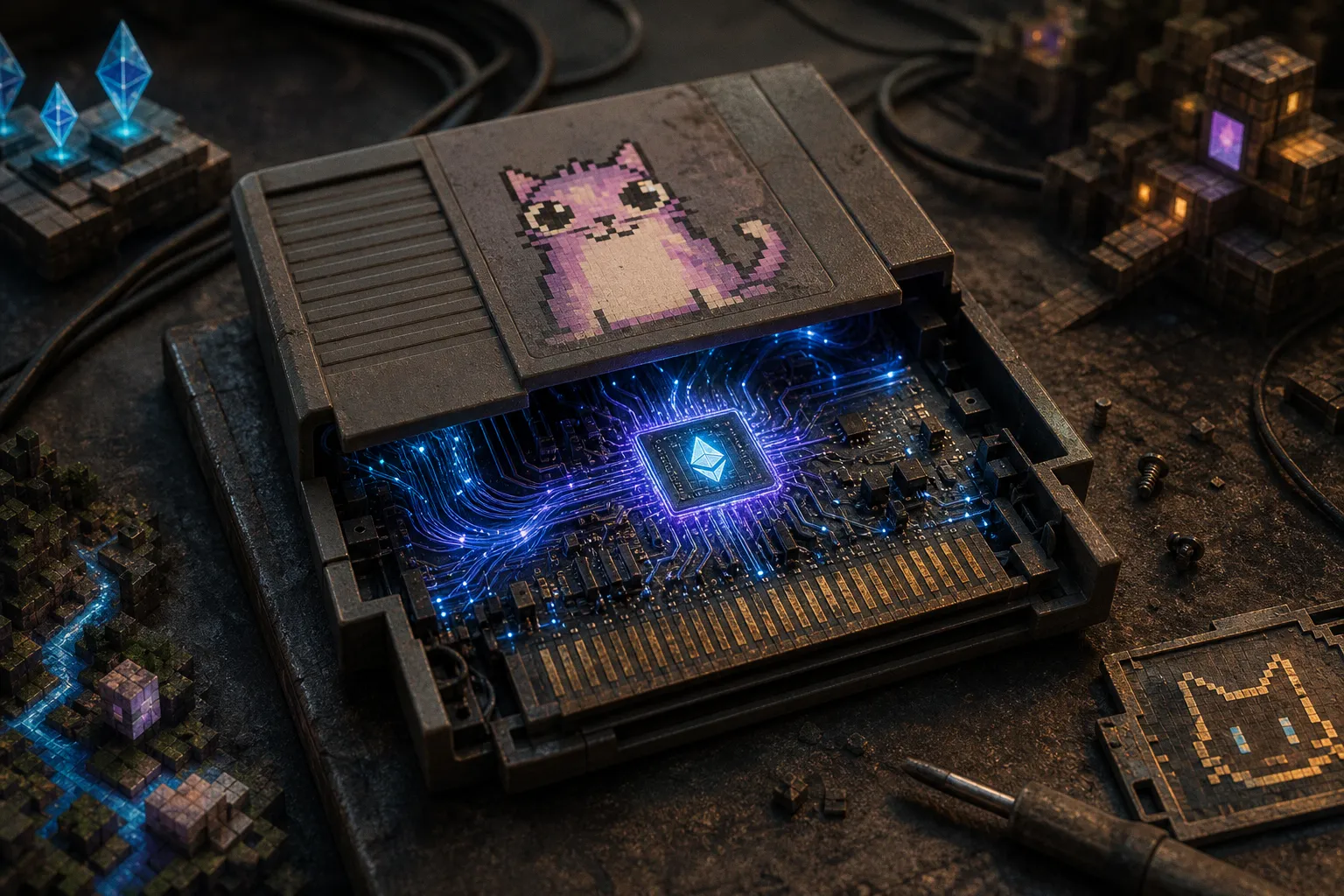
That episode is often treated as folklore in Web3 gaming. It should be read more plainly as an early stress test. The lesson was not that every game needed a blockchain, nor that every collectible should become a token. It was that games place unusual pressure on networks: they generate frequent state changes, social coordination, marketplace activity, and asset movement in patterns that resemble urban traffic more than quarterly finance.
The legacy of congestion: what CryptoKitties actually proved
CryptoKitties arrived at a moment when Ethereum’s cultural imagination was expanding faster than its throughput. The network could process roughly 15–30 transactions per second under normal assumptions, and a sudden consumer application was enough to push fees up and transaction confirmation into uncomfortable territory. For players, the consequence was not abstract congestion. It meant waiting, repricing gas, and discovering that a cute on-chain interaction could behave like a financial settlement.
That gap between game expectation and chain behavior has defined the next seven years of gaming blockchain design. A player expects a breeding action, card trade, equipment craft, land claim, or match reward to feel immediate. A network designed primarily for security and composability expects users to accept latency, variable fees, and public mempool dynamics. These are not moral failures on either side. They are different social contracts.
The first generation of blockchain games often tried to place too much expressive activity directly on the base chain. Asset ownership, marketplace transfers, minting, breeding, and sometimes game logic all competed for the same scarce blockspace used by DeFi traders and token issuers. The outcome was predictable: when demand rose, casual players became price-sensitive outsiders in their own games.
This history matters because it explains why current infrastructure conversations are less theatrical than the earlier rhetoric around “true ownership.” Studios now ask narrower questions:
- Which interactions must be on-chain for asset provenance or market settlement?
- Which can remain off-chain without damaging player trust?
- Which assets need interoperability, and which only need persistence within one game world?
- Who pays for transaction costs when a player does not see the transaction as a financial act?
- How much governance should token holders have over live game balance?
These are not glamorous questions. They are the operating politics of virtual economies. A gaming blockchain is not just a faster ledger; it is a rule-making environment where developers, players, validators, marketplace operators, and liquidity providers negotiate who absorbs cost and who receives control.
The useful history of CryptoKitties is not that it was early. It is that it made infrastructure visible to people who only wanted to play.
From Layer 1 settlement to dedicated gaming Layer 2s
The rise of gaming Layer 2 scaling was an attempt to separate the needs of consumer applications from the bottlenecks of mainnet settlement. Optimistic and zero-knowledge rollups changed the trade-off. Instead of forcing every game transaction into Ethereum’s base-layer throughput, they bundled activity elsewhere and posted proofs or commitments back to a more secure settlement layer.
For gaming, that shift was not merely technical. It altered the social experience of participation. When fees fall by 90–99% compared with Layer 1 activity, and throughput moves toward the thousands of transactions per second, designers can begin to imagine on-chain systems that are not only ceremonial. Marketplace listings, item upgrades, reward claims, and seasonal mints become less punishing. They still are not free in an economic sense, but they stop feeling like a toll booth placed in front of every action.
Dedicated gaming Layer 2s, including ecosystems that emerged in the 2022–2023 period around infrastructure such as Immutable zkEVM and Arbitrum Orbit-based deployments, reflected a more specialized thesis: games need predictable cost, wallet abstraction, NFT standards, marketplace rails, and developer tooling bundled into something that resembles a platform, not just a chain.
The comparison is clearer when the layers are viewed through the daily life of a game rather than through the vocabulary of protocol design.
| Infrastructure layer | What it offers games | Where it strains under game conditions |
|---|---|---|
| Layer 1 | Strong settlement, deep liquidity, broad composability, established security assumptions | Low throughput for game-like frequency, variable fees, poor responsiveness for routine play |
| Gaming Layer 2 | Lower fees, higher throughput, better onboarding tooling, closer alignment with NFT and marketplace activity | Shared blockspace still exists, governance may depend on broader ecosystem priorities, bridging remains a user experience burden |
| Application-specific Layer 3 | Custom gas token, tailored throughput, privacy settings, game-specific sequencing and rules | Fragmented liquidity, additional bridge complexity, smaller validator or operator surface depending on design |
The Layer 2 era also made a subtle correction to early Web3 gaming culture. It became less credible to insist that players should understand every network detail before participating. Traditional games hide enormous technical complexity: matchmaking, anti-cheat systems, content delivery networks, payment processors, database replication, analytics. Web3 games, by contrast, often exposed their machinery and called that exposure empowerment.
The better infrastructure approach is less romantic. It gives players meaningful control where it matters—assets, identity, trade, portable reputation—while hiding the repetitive mechanics of signature prompts and fee calculation. That is why gaming SDKs and embedded wallets became as important as raw throughput.
Why Layer 3 became attractive, and why it is not a universal answer
Layer 3 blockchains are application-specific chains built on top of Layer 2 networks. In gaming terms, they offer a studio the ability to tune the environment around a particular world: gas token selection, transaction ordering, throughput targets, privacy settings, and sometimes governance parameters. The appeal is obvious. A large multiplayer economy does not behave like a decentralized exchange, and a collectible card game does not have the same requirements as an on-chain strategy game with frequent state changes.
For developers, the promise of Layer 3 is not simply “more scaling.” It is administrative sovereignty. A studio can decide whether transaction fees are paid in a native game token, abstracted away, or subsidized directly. It can optimize for sub-second responsiveness where the game loop requires it, while reserving slower settlement for withdrawals, trades, and high-value assets. It can separate the noisy interior life of a game from the more public environment of a shared Layer 2.
But this sovereignty has a cost. Every dedicated chain creates boundaries. Liquidity can become thinner. Bridges become more important and more politically sensitive. Marketplace discovery may fragment across networks. Players who own assets in one game world may find that “interoperability” means something narrower than marketing language suggested: transferable custody, perhaps, but not guaranteed utility.
Land utility illustrates the problem. A tokenized land parcel can be moved, displayed, or sold across compatible marketplaces. Its actual value, however, depends on what the game world allows it to do: produce resources, host events, generate rental income, confer governance weight, or simply signal status. That utility is not carried by the token alone. It is maintained by servers, smart contracts, community norms, and a developer’s willingness to preserve old promises as the game evolves.
The same is true of digital identity. A wallet can serve as a persistent account across games, but identity in a game is social, not merely cryptographic. Reputation comes from guild membership, tournament history, moderation records, cosmetic choices, and the memories of other players. Infrastructure can make identity portable; it cannot make it meaningful by default.
Layer 3s are therefore best understood as instruments for specific economic communities. They are useful when a game or publisher has enough activity to justify its own execution environment and enough discipline to manage the resulting isolation. They are less convincing when used as a status label before a game has demonstrated durable demand.
A dedicated gaming chain can give a world its own monetary weather. It cannot, by itself, make that world worth inhabiting.
SDKs, wallets, and the quiet politics of gas sponsorship
If throughput is the visible side of blockchain gaming infrastructure, onboarding is the part where many projects still lose their audience. A game can run on a fast network and still feel hostile if a new player must install a wallet, manage seed phrases, acquire gas, bridge assets, approve contracts, and interpret signature requests before understanding the game itself.
This is why SDKs have become central to the gaming blockchain stack. Tools such as Immutable Passport and Thirdweb offer pre-built modules for wallet integration, NFT minting, and fiat-to-crypto on-ramps. Their value is not only that they reduce development time. They standardize a set of decisions that individual studios often handle poorly when building from scratch.
The modern Web3 game stack increasingly looks like a layered set of negotiated abstractions:
1. Account creation that resembles a game account, not a trading terminal. Embedded wallets and social login reduce the initial cultural shock, while still allowing more advanced users to export or connect external wallets later.
2. Asset minting that occurs at moments of meaning. Minting a character skin, weapon, card, or land deed works best when it follows a recognizable achievement or purchase. When minting appears before play, it can feel like paperwork.
3. Transaction signing reserved for consequential actions. If every minor upgrade triggers a signature, the interface teaches players to approve blindly. That damages security as well as usability.
4. Fiat on-ramps integrated with regional expectations. A player’s willingness to buy an item with a card, local payment method, stablecoin, or exchange balance differs by market. Infrastructure that ignores that variation imposes a narrow financial culture on a global audience.
5. APIs that let game systems speak to chain systems without turning gameplay into middleware. For teams still assembling this layer, practical work on blockchain API integration for Web3 developers is often less glamorous than token design, but it is closer to the daily engineering burden.
Gas sponsorship is perhaps the most revealing design choice. In many current gaming networks, developers subsidize transaction costs so players experience “gasless” activity. The word is convenient but imprecise. The transaction is not free; the cost has moved from the player to the developer, publisher, treasury, sponsor, or marketplace spread.
That transfer changes governance. If a studio pays gas, it may also claim stronger authority over which transactions deserve subsidy. It can sponsor onboarding, reward claims, and low-value crafting while requiring players to pay for withdrawals or high-frequency marketplace behavior. These policies become economic moderation tools. They shape what players do, what bots can exploit, and which parts of the game feel open.
The subsidy model also places pressure on tokenomics. If the game token is used as gas, price volatility can make routine operations unstable. If a stable asset is used, the economy may become easier to budget but less integrated with the game’s native value system. If the developer absorbs all costs, success itself becomes expensive: more active users mean more transactions to pay for.
This is the mundane truth behind mass adoption. It is not only a matter of making blockchains faster. It is a matter of deciding who can participate without financial literacy, who pays for that simplicity, and how those costs are governed when the user base grows.
Storage: the overlooked infrastructure beneath virtual goods
A sword on-chain is rarely a sword on-chain. More often, the token records ownership and metadata, while the visual asset, animation, texture, 3D model, audio file, or lore description lives elsewhere. Storing large game assets directly on-chain is economically unrealistic for most games. The chain is better used as a registry of ownership and state, not as a warehouse for every polygon and texture.
This is where decentralized storage systems such as IPFS and Arweave enter the stack. They address a problem that is both technical and sociological: players want assurance that the asset they bought will not disappear because a studio changed servers, shut down a CDN, or rewrote metadata after the sale. Persistent storage does not guarantee eternal game utility, but it can preserve the artifact.
The distinction is important. An NFT can point to an image stored through IPFS or a file preserved through Arweave, but the playability of that item still depends on the game recognizing it. A helmet may survive as a file and token while losing its combat function after a balance patch. A land parcel may remain in a wallet after the world around it loses active users. Persistence protects memory and provenance better than it protects economic value.
For infrastructure teams, storage design now requires several separate choices:
- Which data belongs on-chain. Ownership, supply, transfer history, and core state changes are candidates. Large art files and dynamic gameplay data usually are not.
- Which metadata should be mutable. Some games need evolving items, seasonal traits, or upgrade paths. Others benefit from freezing attributes to preserve collector trust.
- How to handle asset versioning. A 3D model may be improved for performance without changing the underlying token. Players need to know whether such updates are maintenance or alteration.
- What happens if the game shuts down. Decentralized storage can preserve files, but it cannot preserve a social world. Shutdown policies are now part of credible infrastructure governance.
The storage bottleneck also complicates interoperability. A marketplace may display a token across networks, but another game must be able to interpret its metadata, trust its origin, and decide whether to grant utility. Open standards help, but game items are context-heavy. A racing car, a spell book, and a parcel of land carry meaning inside rule systems. The file can travel more easily than the rules.
Bridges, node networks, and the governance of movement
Cross-chain bridges sit at the edge of many gaming blockchain designs. They allow assets and value to move between Layer 1, Layer 2, and Layer 3 environments, but they also introduce delay, risk, and user confusion. For high-frequency gaming environments, there are still no universally accepted public benchmarks that settle how bridges should perform under consumer-scale load. The absence of standardized measures leaves communities evaluating bridges through incidents, anecdotes, and the reputation of infrastructure providers.
The bridge is not just a technical corridor. It is a border checkpoint. It determines how easily a player can leave a game economy, sell an asset elsewhere, bring liquidity in, or move identity across ecosystems. The more application-specific chains become, the more politically important bridges become. A game that advertises ownership but makes withdrawal slow, expensive, or fragile invites a predictable governance dispute.
Node networks add another layer to this political economy. Depending on the chain design, validators, sequencers, or other operators may influence uptime, ordering, censorship resistance, and fee markets. In a conventional game, infrastructure failure is customer support. In a Web3 game, it can become a governance event. If a marketplace exploit occurs during network congestion, or if a sequencer outage blocks withdrawals during a token sell-off, the community does not merely ask when service will return. It asks who had power, who was accountable, and whether the rules were neutral.
This is where the language of “player ownership” becomes more demanding than many teams expect. Ownership is not only the right to hold an asset in a wallet. It is the practical ability to transfer, verify, price, and use that asset under rules that are legible before a crisis. Infrastructure determines whether those rights are routine or theatrical.
The next phase: less spectacle, more settlement discipline
The evolution from CryptoKitties to Layer 3s is often narrated as a clean technical ascent: first congestion, then scaling, then customization. The reality is less linear. Each new layer solves a visible problem while producing a new governance surface.
Layer 2s reduced fees and increased throughput, but they did not eliminate questions about bridges, wallet experience, and shared priorities. Layer 3s offer customization, but they can fragment liquidity and identity. SDKs reduce friction, but they concentrate onboarding patterns in the hands of infrastructure providers. Gas sponsorship improves usability, but it shifts costs into treasury design and transaction policy. Decentralized storage preserves assets, but not necessarily the worlds that make those assets valuable.
For builders, the practical direction is becoming clearer. The best gaming blockchain infrastructure does not try to put an entire game on-chain for ideological symmetry. It separates what needs settlement from what needs speed, what needs permanence from what needs iteration, and what needs player control from what needs developer stewardship. That separation is not a retreat from Web3 principles. It is what makes them operational.
For players, the visible change may be quieter. Fewer wallet pop-ups. Faster claims. Assets that can be sold without a tutorial in gas markets. Game accounts that gradually become wallets rather than demanding that wallets become game accounts on day one. Land, skins, cards, and currencies whose rights are described in terms players can test rather than slogans they are asked to trust.
The unresolved question is whether dedicated gaming chains can sustain active societies after the initial asset cycle fades. Infrastructure can lower fees, compress latency, preserve files, and move tokens across borders. It can make a virtual economy technically possible. It cannot guarantee that players will continue to gather there, accept its governance, or believe that its digital identity is worth carrying into the next world.